A few years ago, a well-known maritime technology company, one that no longer exists, rolled out an AI-powered weather routing system. The algorithms were sophisticated. The mathematics were sound. The optimal route it proposed for a voyage was, on paper, perfectly logical.
The master took one look at it and rejected it outright.
The route was not practically navigable. Anyone with real sea-time would have seen it immediately. But the system hadn't been built by people with real sea time. It had been built by people who understood optimisation but not operations or maritime.
That moment didn't just represent a failed feature. It destroyed trust: with the master, with the fleet management team, and ultimately with the market. Because in industries where decisions carry real consequences, credibility is everything. And credibility, once lost, is almost impossible to rebuild.
<blockquote class="pull-quote"> In industries where decisions carry real consequences, credibility is everything. And credibility, once lost, is almost impossible to rebuild. </blockquote>This is the story that plays out across maritime, energy, and asset-intensive industries every time organisations treat AI as a technology problem rather than an experience problem.
The Data Everyone Talks About Is Messier Than Anyone Admits
There is a narrative across industrial technology: collect the data, apply the models, generate the insights. It sounds straightforward. It is anything but.
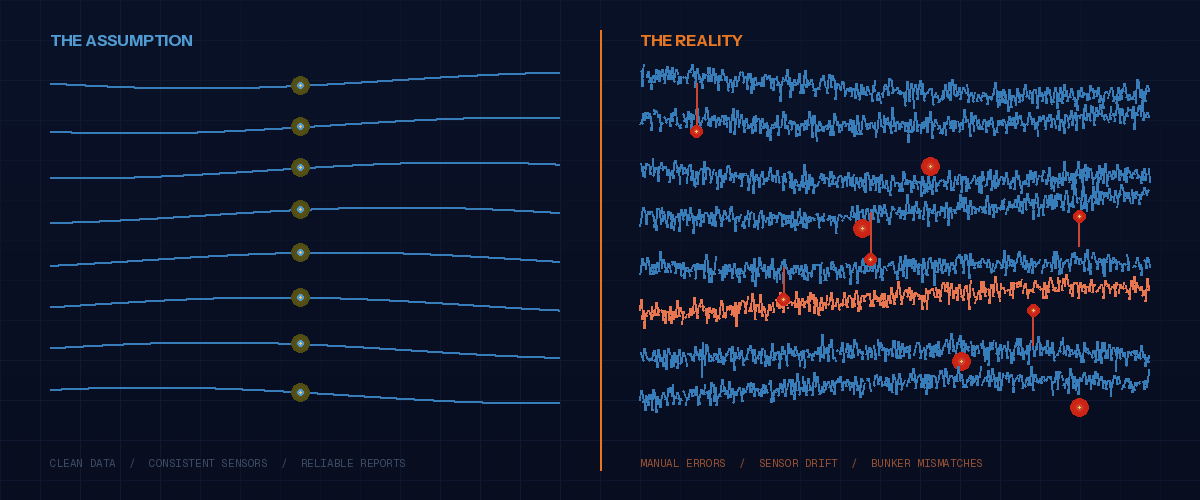
Take something as fundamental as noon reports. The logic is simple to understand. The reality is not. Noon reports contain manual errors: transcription mistakes, misrecorded figures, inconsistent formats across vessels and operators. Bunker delivery quantities don't always match what the supplier claims. High-frequency sensor data should fill the gaps, but sensors drift, break, or simply become unreliable over time.
None of this is exotic. Every operator knows it. But most AI solutions are built as though this data is clean, consistent, and trustworthy. They optimise on top of uncertainty and present the results with false confidence.
<blockquote class="pull-quote"> Most AI solutions are built as though operational data is clean, consistent, and trustworthy. They optimise on top of uncertainty and present the results with false confidence. </blockquote>The people who understand this, who have spent years reconciling these discrepancies, who know which data points to trust and which to question, are not obstacles to digital transformation. They are the foundation of it. Without their judgment shaping what gets fed into models and how outputs get interpreted, AI doesn't just underperform. It misleads.
The Billion-Dollar Lesson: Technology Follows Insight, Not the Other Way Around
One of the world's largest oil and gas companies learned this the hard way, and then got it spectacularly right.
Like most major operators, they had invested heavily in ERP and transactional IT systems. The spending was enormous. The systems worked. But the transformative value everyone had promised remained stubbornly out of reach. The platforms captured transactions, but they didn't illuminate decisions.
The breakthrough came when a specialist technology partner took a fundamentally different approach. Instead of starting with the platform and working outward, they sat down with end users and operational managers, the people closest to the work, and asked a deceptively simple question: what would actually make a difference to how you make decisions?
The insights that emerged were not the ones the ERP programme had been designed to deliver. They were granular, operational, and deeply specific to how the business actually ran. The technology that followed was shaped entirely by that understanding.
<blockquote class="pull-quote"> The platforms captured transactions, but they didn't illuminate decisions. </blockquote>The same company then went further. They brought drilling engineers, people with decades of subsurface experience, into direct co-creation with a technology provider to build a system for minimising the risk of stuck pipe. This is not an abstract problem. A stuck pipe incident can cost millions, delay operations for weeks, and in the worst cases compromise well integrity. The engineers didn't review a finished product and provide feedback. They were embedded in the design and build from day one, shaping every decision the system made.
The result was a tool that worked because it was built on the judgment of the people who understood the problem most deeply. Not technology looking for a use case. Experience looking for amplification.
The Force Multiplier
This is what separates organisations that get real value from AI from those that accumulate expensive experiments.
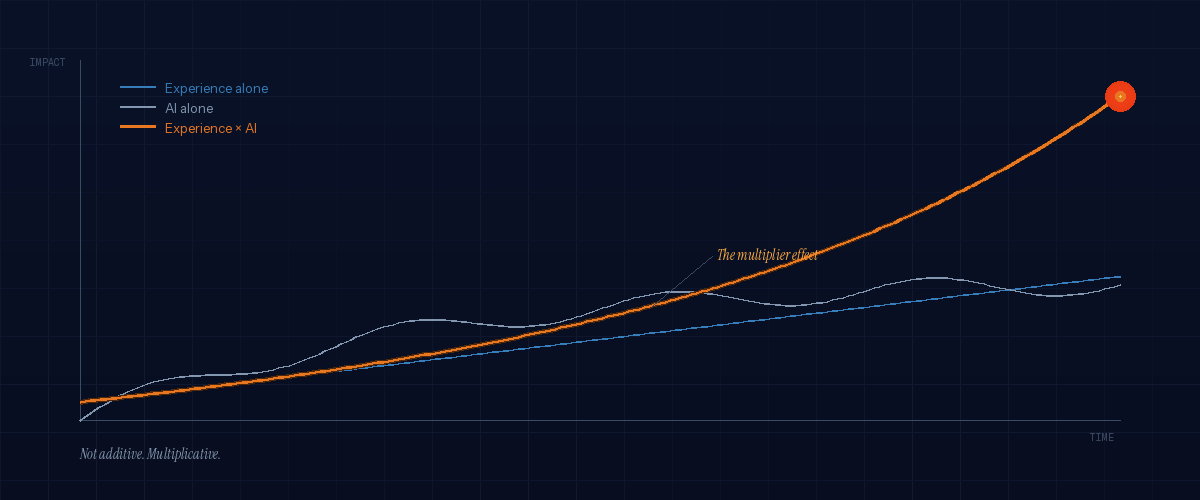
The pattern is consistent. When AI is deployed without deep operational understanding, you get weather routes that no master would sail, dashboards built on data nobody trusts, and insights that look impressive in a boardroom but collapse on contact with reality.
<blockquote class="pull-quote"> Insights that look impressive in a boardroom but collapse on contact with reality. </blockquote>When experienced operators, engineers, and managers are placed at the centre, not consulted at the end, but embedded from the start, the results are transformative. AI becomes a force multiplier for what those people already know. It takes judgment that previously lived in individual heads and makes it systematic, scalable, and immediate.
A fleet manager's intuition about which vessels underperform in specific conditions becomes a predictive model that works across every ship, every voyage, every day. A drilling engineer's hard-won understanding of downhole risk becomes a real-time decision support system that protects every well. An operations manager's knowledge of where the real inefficiencies hide becomes a set of automated alerts that catch problems before they escalate.
The advantage does not belong to those with the most advanced algorithms. It belongs to those who know what questions to ask, what data to trust, and what outcomes actually matter, and then use AI to act on that knowledge at a speed and scale that was previously impossible.
Why Most Transformation Programmes Miss This
The consulting industry has spent two decades selling digital transformation as a technology-led journey: assess the landscape, define the target architecture, build the roadmap, execute over three to five years.
The track record speaks for itself. The majority of these programmes underdeliver. Not because the technology was wrong, but because the approach treated operational knowledge as an input to be gathered rather than the driving force to be amplified.
<blockquote class="pull-quote"> Not technology looking for a use case. Experience looking for amplification. </blockquote>The organisations that break through are the ones that invert the model. They start with what their people know. They identify the specific decisions where better information would change outcomes. And then they build: fast, iteratively, and in direct partnership with the people who will use the result.
Making the Possible Real
The future of maritime, energy and other asset intensive industries is not about AI replacing experience. It is about experience finally getting the tools it deserves.
The operators who have spent decades navigating complexity, managing risk, and finding value in difficult environments are not being made obsolete. They are being given leverage they have never had before. The question is not whether to adopt AI. It is whether you will build it around the people who actually understand your business.
The organisations that get this right will not just improve. They will operate at a level that their competitors cannot match, because the combination of deep experience and AI capability is not additive. It is multiplicative.
<blockquote class="pull-quote"> The combination of deep experience and AI capability is not additive. It is multiplicative. </blockquote>That is not a trend. It is an irreversible shift. And the window to lead rather than follow is open right now.