AINE
AI Native Engineering: The Governance of Intelligence.
I have spent the last decade running technology teams with some of the best engineers I've ever worked with, and have spent the past few months going deep on AI. Not watching from the sidelines, but building with these tools every day. This article started as a question I kept hearing from engineers I respect: is this the end of our profession? I think the answer is more complex than either the optimists or the pessimists suggest.
We need to stop asking if AI will replace engineers. It is the wrong question because it assumes "engineering" is a static target. It isn't!
In February 2025, the industry briefly lost its mind over "vibe coding." Andrej Karpathy's term for yielding control to the model, embracing exponentials, and forgetting the code exists. Collins Dictionary named it their 2025 Word of the Year. Y Combinator reported a quarter of its Winter 2025 batch had codebases that were 95% AI-generated.
The vibes were seductive. They were also a trap.
The profession isn't dying. It is bifurcating. On one side, you have people using AI as a faster typewriter. They generate code without governing it, essentially operating as product managers with a compiler. On the other, a genuinely new discipline is emerging. AI Native Engineering. This is not software engineering assisted by AI. This is sovereign engineering. The discipline of governing probabilistic systems with deterministic constraints.
The Death of Implementation Stamina
For decades, engineering status was correlated with implementation stamina. You were valuable because you could hold complex mental models in your head and translate them into syntax, line by painful line. That era is over. Code is now abundant. Generation is free.
The tools arriving in early 2026 are not autocomplete. They are autonomous agents that plan multi-step tasks, edit dozens of files simultaneously, coordinate dependencies across parallel workstreams, and launch browsers to visually verify their own work. Sixteen AI instances recently collaborated to build a complete C compiler that compiled the Linux kernel across three architectures. These are not assistants. They are workforces.
But the human details are what tell the real story. Boris Cherny, who leads Claude Code at Anthropic, told Fortune that he hasn't personally written code in over two months. His team built Claude Cowork, a graphical interface for non-developers, in roughly a week and a half. They built it using Claude Code itself. Ninety percent of Claude Code's own codebase is now written by Claude Code. The tools are building themselves.
During Spotify's Q4 earnings call, co-CEO Gustav Söderström was even more blunt. "When I speak to my most senior engineers, the best developers we have, they actually say that they have not written a single line of code since December. They only generate code and supervise it."
<blockquote class="pull-quote">When production cost drops to near zero, the value of decision goes to infinity. The bottleneck is no longer "Can we build this?" The bottleneck is "Is this correct?</blockquote>The Mathematical Limit of Vibes
If you want a single image that captures where we are, look at the AtCoder World Tour Finals in Tokyo in July 2025. Widely regarded as the most prestigious heuristic coding competition on the planet, twelve of the world's highest-ranked programmers sat down for a gruelling ten-hour marathon against OpenAI's custom-built AI contestant.
Przemysław "Psyho" Dębiak, a 42-year-old Polish programmer and former OpenAI engineer, won. He beat the AI by 9.5%. But the AI beat every other elite human in the competition. And Dębiak didn't win because he was faster. The AI generated solutions at superhuman speed. He won because the AI was greedy.

The AI optimised for the immediate next step, climbing the nearest hill. Dębiak recognised a global optimisation path that required a counter-intuitive leap. A temporary reduction in score to unlock a higher ceiling. The machine could execute. Only the human could direct.
Dębiak said afterwards: "It is likely that I may be the last human winner." The press called it programming's John Henry moment. That framing is exactly right, and exactly the point.
Steel-Manning the Trap
We should be honest about why vibe coding worked. For 0-to-1 prototyping, it is unbeatable. If you need a demo by Friday, use the vibes. Let the model hallucinate the CSS. Throw away the tests.
<blockquote class="pull-quote">But engineering is not about 0-to-1. It is about 1-to-N.</blockquote>Vibe coding fails at 1-to-N because LLMs are probabilistic engines. As a system grows, the probability of maintaining a coherent codebase creates a vanishing gradient. A December 2025 analysis by CodeRabbit of 470 open-source pull requests found AI co-authored code contained 1.7 times more major issues, with security vulnerabilities appearing at nearly three times the rate of human-written code. In a survey of 18 CTOs, 16 reported production disasters directly caused by AI-generated code.
The speed illusion. METR's randomised controlled trial found that experienced open-source developers using AI tools were objectively 19% slower. Despite believing they were 24% faster. Despite still insisting they were quicker even after seeing the data.

AI reliably generates locally coherent but globally inconsistent solutions. Without rigid guardrails, an AI-maintained codebase decays into entropy faster than a human one. The AINE professional understands this distinction. They use vibes to explore the solution space. They use rigour to lock it down.
Even Karpathy declared vibe coding passé by late 2025, advocating instead for what he now calls "agentic engineering." Acknowledging that orchestrating AI agents is a genuine discipline, not a party trick.
The Unbundling of Engineering
Kent Beck, creator of Extreme Programming and TDD, captured the anxiety perfectly: "90% of my skills just dropped to $0." But the crucial second half: "The leverage for the remaining 10% went up 1000x."
That 10% is AINE. In traditional engineering, seniority meant deeper technical recall. Craft meant precision of implementation. Output scaled linearly with effort. In AINE, seniority means clarity of intent. Craft means precision of constraints. Output scales with judgment.
<blockquote class="pull-quote">Seniority means clarity of intent. Craft means precision of constraints.</blockquote>The AINE practitioner does not write more code. They write less, and decide more.
They orchestrate intelligence rather than manually executing logic. They design systems where humans, models, APIs, and data coexist in feedback loops. They debug probabilistic behaviour instead of deterministic flows. Addy Osmani, a Google engineering lead and author of the O'Reilly book Beyond Vibe Coding, frames it as a question of discipline: starting with a design spec, breaking work into well-scoped tasks, reviewing AI output with the same rigour you'd apply to a human teammate's pull request, and testing relentlessly. Testing, Osmani argues, is the single biggest differentiator between agentic engineering and vibe coding.
The profession is differentiating into distinct profiles. On one axis, we will always need deep infrastructure engineers. People who understand compilers, distributed systems, and safety constraints. On another, AINE product engineers are emerging whose leverage comes from shaping intelligence toward outcomes. Their primary skill is not typing speed. It is decision compression. They reduce ambiguity. They set constraints. They shape architecture so that generative systems produce coherent results.
These are different roles. We should stop pretending they are the same job.
Engineering as Governance
Here is the uncomfortable truth. If your current workflow is reviewing AI-generated code line by line, you are working harder, not smarter. You cannot out-read a system that generates ten thousand lines a minute. Manual review was designed for human-authored code at human speed. It does not scale to the output of an agent workforce.
AINE replaces brute-force review with a governance loop:
The human writes the spec. Not vague requirements. Precise boundary conditions, invariants, and constraints defined so tightly that ambiguity has nowhere to hide. In 2026, the primary artifact of an AINE practitioner is no longer the .ts file. It is the specification.
The AI generates the implementation. Multiple agents work in parallel, producing code, tests, and documentation against the spec.
The system verifies automatically. Not unit tests that check "if input is 5, output is 10." Property-based verification that enforces "for all inputs, output must preserve invariant X." Formal logic rejects what doesn't hold.
The loop repeats or commits. If verification fails, the AI regenerates against the failure signal. If it passes, the code ships. The human never reads ten thousand lines. They read the spec, the verification report, and the diff against the last known good state.
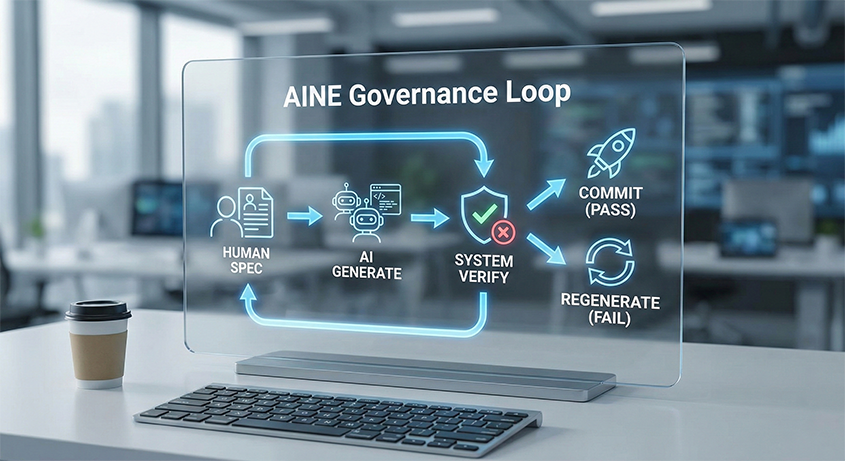
This is context engineering as systems design. Not prompt engineering. The systemic architecture of information flow, designing exactly what data reaches the agent, when, and in what structure. Anthropic's own research has demonstrated that sophisticated context engineering with a less powerful model consistently outperforms raw frontier models with poor context discipline.
The shift is this: ambiguity used to be resolved by you, as you typed. Now, ambiguity is magnified by the model into catastrophe. If you cannot articulate exactly what you want, you can no longer engineer.
Sovereignty or Submission
AINE stands for AI Native Engineering, but the name is also a deliberate nod to Áine, the Irish goddess of sovereignty and radiance. In Celtic mythology, Áine conferred the right to rule. Her favour meant fertile land and prosperous people. Her withdrawal meant barren fields and the collapse of kingdoms.
The metaphor is precise. Sovereignty over your systems is not granted by default. It is enforced through clarity of thought, rigour of specification, and the willingness to exercise judgment rather than defer it. Engineers who abdicate that sovereignty, who accept AI output uncritically, who skip verification, who let vibes substitute for architecture, will find themselves maintaining systems they do not understand. Terrified to touch a line of code because they don't know which Jenga block holds up the tower.

Those who claim sovereignty deliberately will find their leverage multiplied beyond anything the previous era of engineering could offer. Áine's name means "brightness."
<blockquote class="pull-quote">In a landscape increasingly flooded with generated noise, brightness of thought is the scarcest resource of all.</blockquote>Dębiak didn't out-type the machine. He out-thought it. That is the entire thesis of AINE in a single sentence.
We don't mourn the loss of hand-stitching skills because sewing machines exist. We don't consider architects less skilled because they don't lay bricks. AI is commoditising implementation and making judgment more valuable than it has ever been.
The defining capability of the AINE practitioner is not the ability to write code without assistance. It is the ability to think clearly with it. The engine provides the torque. The engineer provides the vector.
The vibes were fun. The engineering is what matters.